
Refurbished Miners: Pricing the Repair Before You Buy
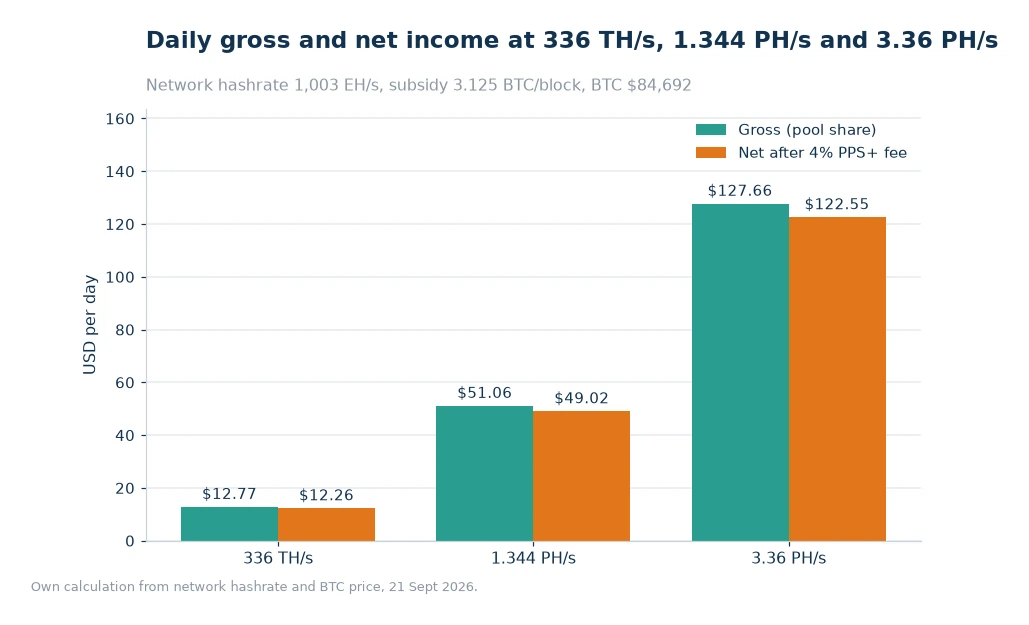
A used machine that hashes at 336 TH/s earns roughly 0.00015075 BTC a day, $12.77 gross and $12.26 net at $84,692. The discount on a refurbished unit looks like free money until the first board fails. Three percentage points of uptime are worth about $134 a year at this hashrate, which is often the whole gap between a used price and a new one.
Key takeaways
- Net income at 336 TH/s is $12.26 a day, so every day offline costs about that much.
- Five points of uptime are worth roughly $224 a year, which can erase a used-machine discount.
- Budget a spare fan and PSU per machine before the first failure, not after it.
- Inspect the power connectors and the board screws; those two details reveal how the machine was treated.
The history you cannot inspect
A used miner arrives with a hashrate and a price. It does not arrive with a record of the room it lived in, the number of brownouts it survived, or whether it ran at 90% fan speed for two summers. Those facts are embedded in the hardware, and the inspection is an attempt to read them from the outside.
Some of the history is legible. Discoloured power connectors suggest heat. Stripped screws suggest repeated disassembly. A heatsink packed with dust suggests a room without filtration. None of these is disqualifying on its own, and together they describe an owner who did not maintain the machine, which is the thing a buyer is really trying to price.
What a refurbished price includes
Refurbished is not a standard. It can mean a machine that was cleaned, tested and had its thermal paste replaced, or it can mean a machine that powered on for ten minutes and was listed. The price difference between those two definitions is the value of the work, and the listing rarely distinguishes them.
Ask three questions in writing: what was replaced, what the measured hashrate was after the work, and what warranty covers the boards. A seller who answers all three has done the work. A seller who answers only the first has probably cleaned the case and shipped it.
336 TH/s and the value of an uptime point
Uptime is the variable that connects a repair budget to a revenue forecast. A machine that is offline cannot earn, and at this hashrate a day of downtime costs a little over twelve dollars. Over a year, a few percentage points of availability become a number large enough to change the purchase decision.
| Uptime | Days lost per year | BTC forgone | USD forgone |
|---|---|---|---|
| 98% | 7.3 | 0.00105646 | $89.47 |
| 95% | 18.25 | 0.00264114 | $223.65 |
| 90% | 36.5 | 0.00528228 | $447.31 |
The gap between the first and second row is $134.18 a year. That figure is worth weighing against the price gap between a well-refurbished unit and a cheap one, and it also justifies a spare PSU on the shelf. The part costs less than the downtime it prevents.
Spare parts as a budget line
Refurbished hardware fails in predictable places: fans, power supplies and the connectors between them. Those are also the cheapest parts to keep. A budget of one fan and one PSU per machine covers most first-year failures without a shipping delay, which is the real cost of a breakdown.
The alternative is to buy from a seller who stocks parts and ships quickly. That is worth paying for, but only if the seller is still in business when the part is needed. Holding the spares yourself removes that dependency, and it costs less than a single day of downtime per year at this hashrate.
The point where a repair stops making sense
Every machine has a repair ceiling: the amount beyond which the money is better spent on a newer unit. The ceiling depends on the machine's efficiency, the local power price and the current difficulty, not on sentiment. A board replacement that costs three months of net credit is usually the wrong call on an old, inefficient machine and a reasonable one on a recent model.
Compute the ceiling as a share of the machine's remaining earning life. If a repair costs more than a third of what the machine will produce before it becomes uncompetitive, the repair is a bet on the network standing still. Difficulty rarely stands still.
An inspection list for a used machine
Six checks cover most of the risk. Look at the power connectors for browning. Look at the fan blades for cracks and dust scars. Look at the board screws for tool marks. Ask for a thirty-minute hashrate log rather than a screenshot. Check that the serial numbers on the boards match the case. And run it for an hour at the ambient temperature of your own room, not the seller's air-conditioned workshop.
That last check catches more problems than the other five combined. A machine that runs at 60°C in a cool room may throttle at 80°C in a shed in July, and the seller's test says nothing about it. If the seller will not allow a warm-room test, discount the price accordingly.
Pointing the first day at your own account
A used machine is usually bought to replace an older one or to fill a spare slot, and the first question after it arrives is whether it earns what the seller claimed. Point it at the ViaBTC Bitcoin Mining account you already use, give it its own worker name, and compare the first full day of credits with the arithmetic.
The comparison takes a day and settles the purchase. If the machine produces the expected credit at the expected hashrate, the refurbishment was honest. If it produces less, the shortfall is either the machine or the room, and the temperature log tells you which.
Worked example: the annual cost of a weak unit
The arithmetic starts from the daily credit and then applies an uptime assumption.
- 450 BTC ÷ 1,003,000,000 TH/s = 0.00000044865 BTC per TH/s a day.
- 336 × 0.00000044865 = 0.00015075 BTC, or $12.77 at $84,692.
- Net after the 4% block-reward charge: 0.00015075 × 0.96 = 0.00014472 BTC, or $12.26.
- At 95% uptime: 0.05 × 365 = 18.25 days lost a year.
- 18.25 × 0.00014472 = 0.00264114 BTC, which is $223.65.
- At 98% uptime: 7.3 days lost, 0.00105646 BTC, or $89.47.
- The three-point difference is $134.18 a year, about eleven days of net credit.
Frequently asked questions
What is a day of downtime worth at 336 TH/s?
About $12.26 a day, so three percentage points of uptime across a year are worth roughly $134 at $84,692, which is often the entire gap between a cheap used unit and a properly refurbished one.
What should I check first on a used miner?
The power connectors and the board screws, because browning and tool marks reveal heat and repeated disassembly, and then run it for an hour in a warm room to see whether it throttles.
When is a repair no longer worth it?
When the part costs more than about a third of what the machine will earn before it becomes uncompetitive, since that repair is effectively a bet that difficulty will not rise.
Price the second year, not the first
The purchase price is a one-off; the uptime is annual. Write down the expected net credit, subtract a realistic availability figure, and add the spare parts you will need. If the total still beats a new machine over two years, the used unit is a good buy. The Miner Profitability Ranking gives the model comparison and the Profit Calculator turns it into a daily figure at current difficulty, which is where the inspection should have started.
Sources: ViaBTC miner ranking, calculator and pricing pages, with chain data read 21 Sept 2026 — network hashrate 1,003 EH/s, difficulty 132.76 T, 3.125 BTC per block, 144 blocks a day, BTC $84,692. Uptime levels are illustrative scenarios. Published 24 Oct 2026[1].