
OEM/ODM Jewelry Manufacturing for Growing Fashion Brands
A growing fashion brand rarely needs 5,000 pieces of one design. It needs a small run of six or eight designs, delivered with packaging, on a schedule it can plan around. The MOQ by base material is 100 plus in stainless steel, 100 units in eco-brass and 50 pcs in sterling silver, by design, so a two-design range doubles those figures.
Key takeaways
- The lowest published entry is 50 pieces per design in 925 sterling silver, which suits a first collection.
- Sampling at 25–30 days and production at 3–4 weeks are the two blocks to plan a launch around.
- Six customisation fields are specified before sampling, including packaging and hallmarks.
- A 24-hour response, a dedicated project manager and a 100% NDA cover the relationship side.
Starting small without starting badly
A first collection usually has one budget and several unknowns. The published minimums let a brand test a silhouette at 50 pieces per design in silver before committing a larger order to a plated line at 100 pieces.
The mistake to avoid is cutting corners on the specification to save development time. Skipping the CAD stage or the sample approval does not produce a cheaper product, it produces a product with unknown plating and unknown weight, sold to customers who cannot return it easily.
Designing a capsule that shares tooling
Six customisation fields are published, and two of them - chains and findings, and stones and accents - are shared across a collection more often than brands realise. Designing around common findings reduces the number of new moulds and keeps sampling cycles predictable.
It also simplifies packaging. A range that uses one box size, one pouch size and one backing card format needs five packaging item types specified once, rather than five specified per design.
| Decision | Published figure | Why it matters to a new brand |
|---|---|---|
| Silver minimum per design | 50 pcs | Smallest launch the factory publishes |
| Brass minimum per design | 100 pcs | Lowest-cost metal for a plated range |
| Stainless steel minimum | 100+ pcs | Everyday-wear pricing bands |
| Sampling window | 25–30 days | Launch date once CAD is approved |
| Production block | 3–4 weeks | Reorder planning |
The launch calendar a small brand can actually hold
Work backwards from the two published windows. Sampling is 25–30 days, production 3–4 weeks, and both start only when the gate before them closes. A capsule of three designs run in parallel lives inside those windows; three designs run one after another take three times as long.
That is the argument for approving all CAD models together. The 48-hour CAD stage is the only part of the pipeline that can genuinely overlap, so it should be the part that does.
Where inspection protects a young brand
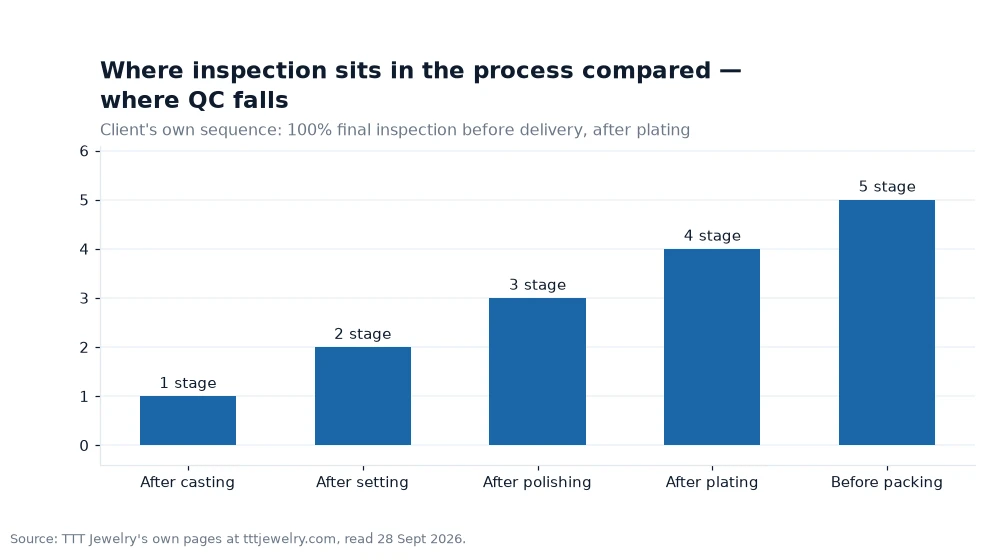
A brand without a quality team depends on the factory's inspection stage. The published rule is 100% inspection before packing, which means each piece is looked at rather than sampled.
For a new label, that is the difference between a launch and a customer service problem. A TTT OEM ODM Manufacturer relationship also carries ISO 9001:2015, REACH compliance on lead, cadmium and nickel and a BSCI social audit, cadmium and nickel, all of which a young brand can reuse when pitching to stockists.
Growing the order after the first reorder
The second order is where the economics improve. The mould exists, the plating specification is fixed and the packaging artwork is approved, so only the 3–4 week production block and its inspection have to be scheduled again.
That is the moment to test a new material or a new finish, because the base order is running without management attention. Reorders at the silver, brass or stainless minimum are the least expensive experiments a growing brand can run.
Pricing a capsule against the published minimums
A capsule is quoted design by design, so the minimum is what sets the floor. In silver that is 50 pieces per design; a four-design capsule therefore starts at 4 × 50 = 200 pieces, spread across a 25–30 day sampling cycle and a 3–4 week production block.
Adding a second material to the same capsule widens the range without multiplying the schedule, because CAD work is the only stage that overlaps cleanly across designs.
What to do when one design sells and three do not
Reorders are the least expensive product development a brand can do. The mould exists, the plating specification is fixed and the packaging artwork is approved, so the 3–4 week production block is the only part of the timeline that has to be scheduled again.
That is also the moment to test a variant on existing tooling: a new finish, a new stone or a longer chain. Under a 100% NDA and with ISO 9001:2015 documentation behind the batch, the second run is where a small brand builds the confidence to widen a range.
Building a range around one specification sheet
The least expensive complexity in a jewellery business is the kind you avoid. A range that shares a chain gauge, a clasp type and a backing card format needs fewer new components and less new packaging on every release.
Six customisation fields are published, and most of them can be held constant across a season while the silhouette changes. Held constant, they make reorders quick, because the plating specification and the hallmark are already agreed.
The published minimums then do the rest of the work: 50 pieces per design in silver for the pieces that carry the price, 100 in brass for volume, 100+ in stainless steel for everyday wear.
Worked example: what a capsule of three designs costs in calendar time
Take a three-design capsule in silver, all at the published 50-piece minimum. The quantity is 3 × 50 = 150 pieces, and the order is bought once rather than three times.
Schedule it in parallel. All three CAD models arrive inside the same 48-hour window, which is 2 days. Sampling runs 25–30 days, and production 3–4 weeks, which is 21–28 days. The parallel path works out at 48 days, 2 + 25 + 21, when nothing slips, or 60 days, 2 + 30 + 28, at worst.
Serialised instead, each design waits for the one before it, so the same capsule occupies 3 × 48 = 144 days to 3 × 60 = 180 days. Running designs in parallel rather than one at a time is worth roughly two to four months on a first collection, which is the single biggest scheduling lever a small brand has.
Frequently asked questions
How many designs can a first collection hold?
There is no published cap on design count, but each design carries its own minimum of 50 pieces per design in 925 sterling silver, so a capsule is priced one design at a time.
Can I start with fewer than 100 pieces?
Yes, in silver. The minimums are 50 pcs in 925 silver, 100 in eco-brass and 100+ pcs in stainless work, per design, applied design by design.
What support does a small brand get?
A project manager assigned 1-on-1, a reply inside 24 hours, 100% inspection before packing, plus a 100% NDA covering the moulds and CAD files.
Turning a capsule into a supply chain
Buy the first collection small, then reinvest the margin into a wider range on the tooling you already own. Keep every design on one specification sheet so a reorder six months later still matches. The wholesale programme explains how repeat runs are quoted, and the eco-brass range shows the 100-piece plated route for volume pieces.
Nothing here is invented — the laser engraving option, followed by the master-sample benchmark plus the packaging set — all of it comes from the maker's own site through tttjewelry.com, dated 28 Sept 2026. No figure above is estimated. The sums that follow from those inputs are my own arithmetic rather than the manufacturer's[1].