
Red flags in a scented home and personal care proposal are rarely dramatic. They are small omissions: a specification with no version number, a testing answer that arrives without a scope, a quotation that prices the fill but not the decoration. Individually each is easy to overlook, which is precisely why they matter, because they predict how the same company will behave once a festive gifting range is on the critical path and there is no time to repair a process that was never there. The useful approach is not to hunt for disqualifying facts but to notice which questions produce a specific answer and which produce a reassuring one.
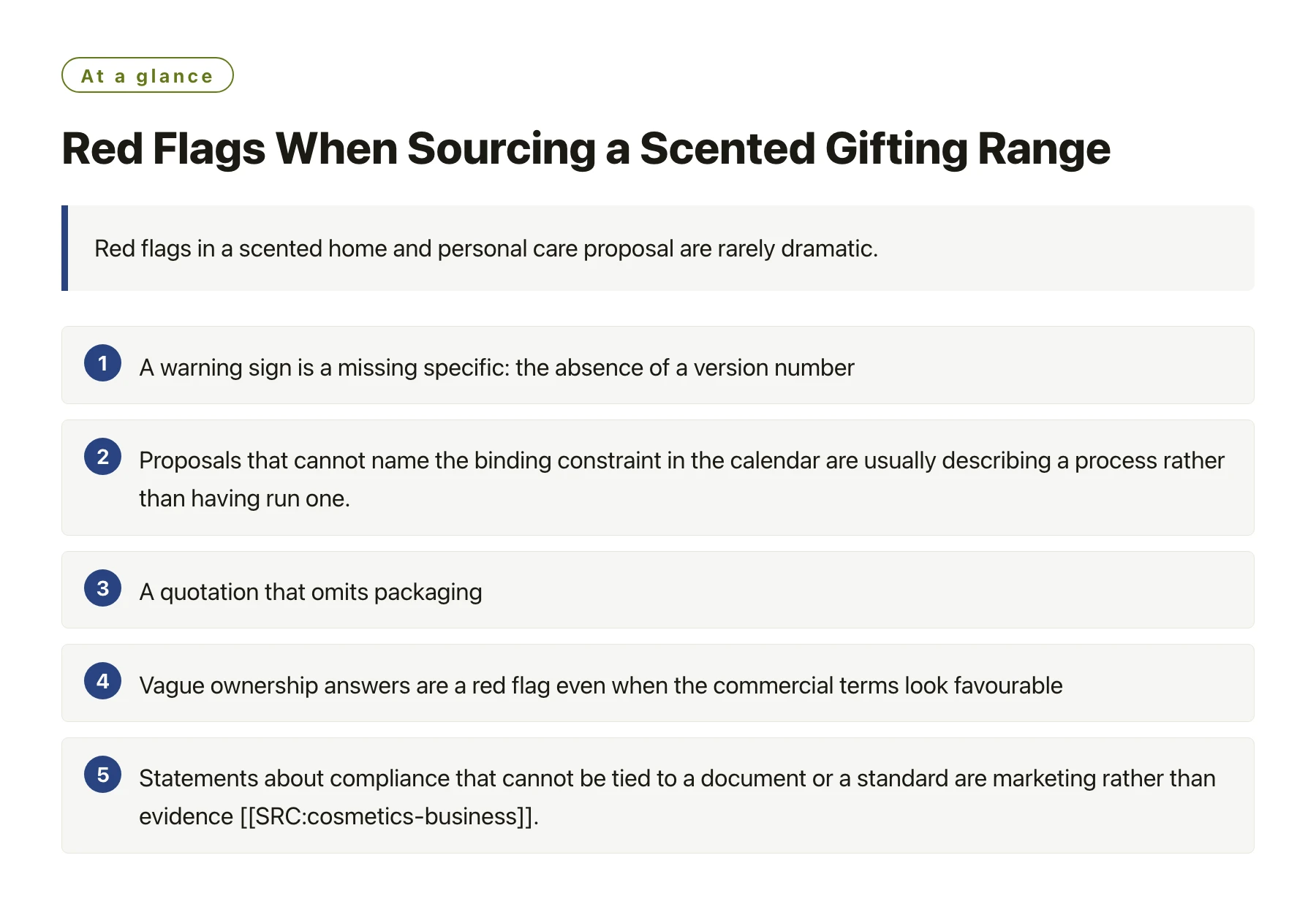
Key takeawaysA warning sign is a missing specific: the absence of a version number, a named test, a stated tolerance or a stage calendar says more than the presence of confident language. · Proposals that cannot name the binding constraint in the calendar are usually describing a process rather than having run one. · A quotation that omits packaging, decoration, testing or freight is not cheaper; it is incomplete, and the omitted work returns later at a worse moment. · Vague ownership answers are a red flag even when the commercial terms look favourable, because reuse of the scent at reorder is the asset the brand is actually buying. · Statements about compliance that cannot be tied to a document or a standard are marketing rather than evidence [1]. · The strongest positive signal is not enthusiasm but precision: a supplier that corrects the brief, names a limitation and states what it cannot do is describing a real operation.
Most sourcing advice tells buyers what to look for. It is more useful to know what the absence of something means, because proposals are written to be attractive and the gaps are where the information sits. A factory that cannot tell you which stage of the calendar usually slips either has not tracked it or does not want to say.
Home and personal care ranges produce a specific family of gaps, because the work spans several formats and two regulatory worlds. A supplier comfortable in fine fragrance may answer home care questions confidently and imprecisely, and the imprecision surfaces later as a reformulation or a label problem.
Here is the set of warning signs worth acting on before a festive gifting range is committed, with the question that resolves each one in a single conversation.
Warning signs, what they usually mean, and how to test them
| Warning sign | What it usually means | Question that resolves it |
|---|---|---|
| Specifications arrive without version numbers or dates | Changes are not being tracked in a way the buyer can verify | Ask for the revision history of one recent formula and which version is currently in production |
| Testing is described but never scoped | Either the scope has not been defined or the supplier is not the party doing it | Ask which combinations are tested, under which conditions, and who signs the report |
| The quotation has no stated assumptions or exclusions | The price is indicative rather than constructed, and the gap will reappear as a change order | Ask for the exclusions list and what would trigger an additional charge |
| No stage of the calendar is identified as the constraint | The supplier has not modelled the project sequence for a seasonal deadline | Ask which stage most often delays them and what they do about it |
| Ownership questions get general answers | The commercial position has not been decided, or it is deliberately being left open | Ask separately about use rights, exclusivity, ownership and what happens at termination |
| Compliance is asserted without a document or standard | The claim is marketing rather than a reference the brand can verify [1] | Ask which standard applies, who holds the certificate or report, and when it was last reviewed |
| Every question receives an immediate yes | The proposal is being shaped to win the order rather than to describe the work | Ask what the supplier would recommend changing in the brief, and listen for a limitation |
Each question in the third column is answerable in a normal conversation. That is the point: none of them requires auditing or legal review, and each produces a fact rather than an impression. Running the list across two proposals also makes them comparable in a way that a side-by-side price comparison never does, which is the same logic behind a due diligence approach to a perfume manufacturer that asks for artefacts instead of assurances due diligence on a perfume manufacturer.
The red flags specific to multi-format ranges
When one scent appears in several products, an additional category of risk appears with it. The scent has to be adapted per base, tested per pack, and still read as one family. A supplier that answers multi-format questions with a single formula answer is either extremely experienced or has not understood the question, and the follow-up conversation distinguishes the two quickly.
The same applies to regulatory scope. Products applied to skin and products used around the home follow different frameworks in many markets, and a proposal that treats the whole range as one category will produce a label problem in at least one item. Asking where the boundary falls is not a trick question; it is a reasonable one that a real operation answers without hesitation.
Signals in the sample round
The sample round is where process gaps become visible earliest. Candidates delivered without coded labels, without a written description of the direction, or without a statement of what was changed between rounds make it difficult for the brand to evaluate anything. A supplier that documents each round is producing the same information it will need later for production; one that does not is showing how it will handle specification changes.
It is also worth noticing how the sample is packaged and whether it arrived with any instruction for evaluation. Small professional habits in sampling tend to be present or absent across the whole relationship.
Signals in the calendar discussion
Ask a prospective supplier to walk backwards from a delivery date and name the latest point at which the brief can be settled. A supplier that can do this on a call has a working model of a seasonal project. A supplier that responds with a general assurance about capacity has answered a different question.
For a festive gifting range, the calendar conversation is also the moment to ask about decoration capacity, since that is where seasonal work concentrates. It is entirely reasonable to ask what happens if a decoration trial fails, how quickly a second trial can be scheduled, and whether that step is inside the supplier's operation or outside it. A partner that has handled seasonal ranges before will treat those questions as normal, and one that has not will treat them as difficult.
The counter-intuitive positive signal
The clearest sign of a capable partner is not enthusiasm but a limitation. When a supplier says a particular format is not a good fit for its line, or that a requested finish will not reproduce consistently, it is describing the boundary of what it controls. Operations that know their boundaries tend to produce fewer surprises, because they are not committing to work they cannot see through.
That is also why project material is worth reading for the problem rather than the product. Published examples of fragrance projects that describe a constraint and how it was resolved provide a preview of how a supplier behaves under pressure, which is precisely the information a proposal cannot supply.
If two proposals look equally attractive and one of them contains a limitation while the other contains only promises, weight the limitation. A supplier that has told you what it cannot do has given you something to plan around; a supplier that has promised everything has given you a checklist to verify under time pressure. On a festive gifting range, that difference often decides whether the season is calm or a sequence of emergencies, and it is the kind of signal that survives the transition from proposal to production, which is where the Xuelei brand and others in this market are ultimately judged.
Sources
- Cosmetics Business —— A trade publication covering the beauty and cosmetics industry, including fragrance launches and regulatory developments.
Frequently asked questions
What is the single strongest red flag in a fragrance proposal?
The absence of specifics. A proposal that names no assumptions, no exclusions, no test scope and no calendar constraint is not describing a project, it is describing a willingness to take the order. Specificity is the cheapest available evidence of an operation that has done the work before.
Are low quotations a red flag?
Not by themselves. A low quotation becomes a red flag when the scope is unclear, because the difference usually sits in work that has been left out rather than in efficiency. Comparing scope line by line, including decoration, testing and freight, is the only way to read a price.
How can a brand check compliance claims?
Ask which standard or framework applies, who holds the certificate or report, and when it was last reviewed. A claim that cannot be tied to a document or a named standard is marketing, and it should not be treated as part of the product's risk position.
Why is a supplier who names a limitation a better sign?
Because it shows the supplier understands the boundary of what it controls. Companies that state limits are usually the ones that also state what they will do when something goes wrong, which is more useful than an unconditional promise.
When is it too late to walk away from a supplier?
The practical cut-off is before tooling and specification freeze. After that, changing partners means redoing artwork, tooling and often testing. This is why the warning-sign conversation belongs in the quotation stage, when the cost of acting on an answer is still low.